Modern European Estate Architecture - The Estate Refectory
Updated: Feb 13


Where gathering becomes ritual
There are rooms shaped by function, and there are rooms shaped by intention.
The estate refectory belongs to the latter. It is not a dining room in the domestic sense, nor a space driven by comfort or informality. It is architecture calibrated for collective presence - a room where proportion, material, and light establish a framework for gathering that feels deliberate, grounded, and enduring.
Here, dining is not incidental. It is ritualized through space.
Architecture as Order
The estate refectory is organized around a single governing principle - axis.
From entry to terminus, the room is structured along a clear longitudinal line that aligns architecture, furniture, and landscape into one continuous sequence. The table becomes a datum rather than an object. It is not placed within the room so much as it is part of the room’s geometry, extending the axis and reinforcing hierarchy.
Nothing competes with this alignment. Secondary elements retreat. Circulation is absorbed into the perimeter. The space reads immediately as ordered, intentional, and settled.
This clarity is not decorative. It is structural.
Mass, Depth, and Containment
The walls of the estate refectory are not treated as surfaces. They are treated as mass.
Plaster and stone are applied in a way that preserves thickness and depth. Openings are carved rather than inserted, allowing shadow to accumulate at edges and reveals. The architecture does not attempt to dissolve itself through transparency. It remains present, enclosing the space with authority.
Arched apertures puncture the perimeter at measured intervals. Their scale is vertical, pulling the eye upward and reinforcing the room’s height, while their repetition establishes rhythm without monotony. These arches are not ornamental gestures. They are voids cut from solid volume, legible as acts of subtraction rather than decoration.
Containment is never lost, even where daylight is abundant.
Ceiling as Continuation
The ceiling is a continuation of the walls, not a separate layer.
Coffers, vaults, and recessed planes are scaled to the length of the room and aligned precisely with the axis below. Their geometry is calm, measured, and disciplined. Nothing is gratuitous. Nothing is expressive for its own sake.
Light is concealed, allowed to wash surfaces rather than announce itself. Shadow becomes a design tool, deepening edges and preserving depth. The ceiling reads as weight-bearing, even when abstracted, reinforcing the sense that the room is held together by mass rather than assembly.
Chandeliers are introduced sparingly and with intent. Each fixture is centered precisely, suspended as a vertical counterpoint to the horizontal datum of the table. Their role is not to decorate, but to bind scale - human presence to architectural volume.
The Estate Refectory Through Six Architectural Studies
Rather than a single fixed solution, the estate refectory is explored here through six architectural positions. Each study tests how proportion, enclosure, material, and light can support gathering without spectacle.
These are not variations in style. They are variations in structure.
Image 1 - The Axial Refectory
This study establishes the refectory through absolute alignment.
A long stone floor plane reinforces direction, while the table extends the primary axis without emphasis. Tall arched glazing terminates the view, framing landscape as an extension of the architectural order rather than a competing element.
Plaster walls remain calm and continuous. Wood is recessed and secondary. The room reads as one continuous volume, defined by orientation rather than decoration.
Gathering here is structured, not choreographed.
Image 2 - The Framed Terminus
In this study, the end condition becomes the architectural anchor.
A dominant arched opening pulls the room forward, compressing the space behind it and intensifying the sense of arrival. Light enters directionally, grazing plaster surfaces and revealing depth at edges and reveals.
Material restraint allows geometry to carry the space. Stone, plaster, and darkened metal remain legible and quiet. The room gains presence through clarity rather than scale alone.
Image 3 - The Suspended Datum
Here, vertical alignment becomes the defining gesture.
A precisely centered chandelier aligns with the table below, creating a suspended datum that binds ceiling and floor. The architecture remains dominant, but the vertical relationship introduces a moment of focus without hierarchy collapse.
Arches repeat rhythmically. Coffered planes above deepen shadow. The room feels tall, measured, and composed - monumental without excess.
Image 4 - The Vaulted Procession
This study emphasizes movement through repetition.
A sequence of shallow plaster vaults introduces cadence overhead, guiding the eye forward while maintaining restraint. Indirect lighting traces the curvature without flattening it, allowing shadow to articulate form.
Stone floors and timber accents ground the experience. The room unfolds gradually, revealing scale through progression rather than immediacy.
Image 5 - The Calibrated Enclosure
Here, the refectory tightens slightly.
Wall thickness becomes more pronounced. Openings are fewer. The space gains intimacy without sacrificing authority. Material continuity between floor, wall, and ceiling reinforces enclosure, while symmetry stabilizes the composition.
This is a refectory designed for prolonged occupation - quieter, heavier, and inwardly focused.
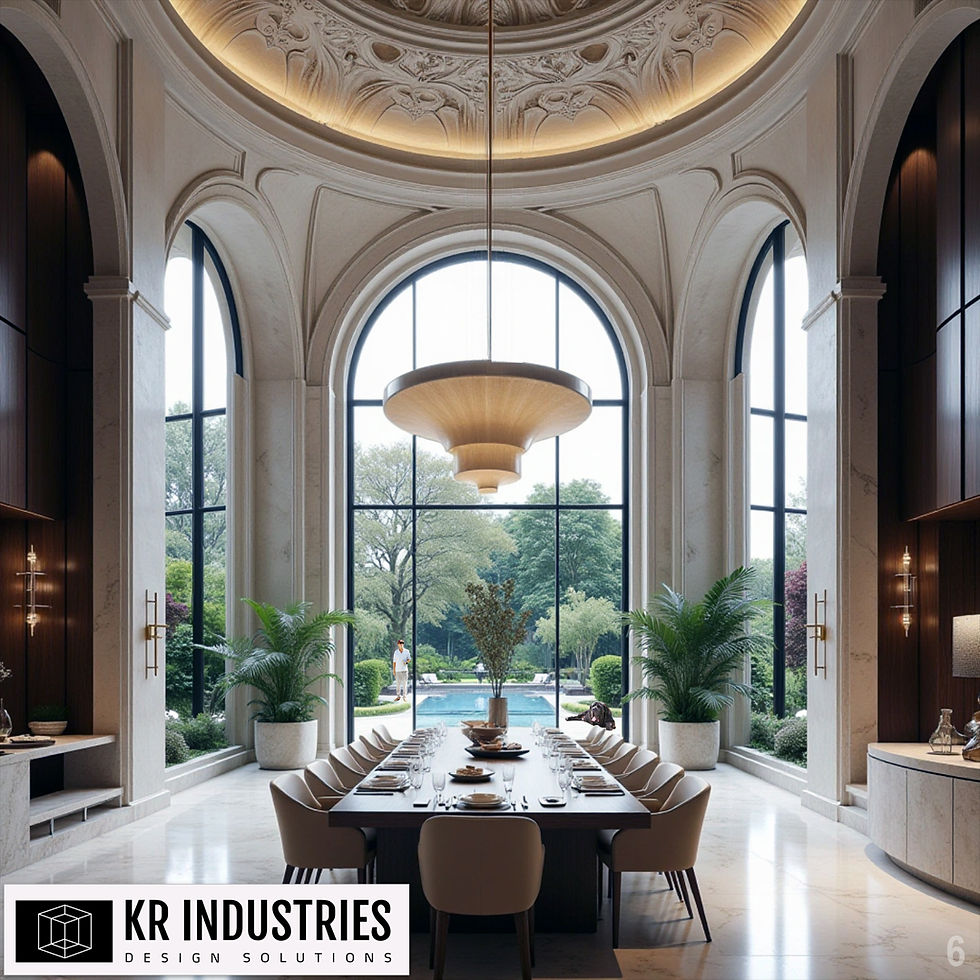
Image 6 - The Resolved Hall
The final study presents the refectory in its most settled state.
Ceiling geometry, arched apertures, and material hierarchy align without tension. Stone carries permanence. Plaster softens light. Wood introduces warmth at the perimeter. Nothing competes. Nothing performs.
The room feels complete - not static, but resolved.
Completion Without Excess
Across all six studies, restraint remains the governing principle.
There is no ornamental surplus. No stylistic borrowing. No performative gesture. Every element has a reason for being present, and every decision reinforces the room’s underlying order.
This is architecture that knows when to stop.
Not because it lacks ambition, but because it understands discipline.
Endurance
The estate refectory is not designed for novelty. It is designed for repetition - meals repeated over years, conversations repeated across generations, light repeated day after day along the same axis.
Its success lies in its ability to remain relevant without adaptation. It does not chase contemporary taste. It establishes its own internal logic and holds it.
This is architecture that does not ask to be noticed. It asks to be inhabited.
At KR Industries, architecture is not assembled. It is authored.
Continuing Through Gathering
The estate refectory occupies a pivotal position within the larger architectural sequence of the home.
If earlier spaces establish arrival and reflection, this room formalizes gathering. It gives structure to collective time - meals, conversations, and rituals that repeat across days and generations. Its role is not to impress, but to endure.
In the chapters ahead, this architectural sequence will continue to unfold through other estate interiors - spaces that support daily life while reinforcing hierarchy, proportion, and restraint. Rooms where architecture becomes quieter, more private, and increasingly personal.
Because a home is not defined by any single space. It is defined by how those spaces relate.
If you would like to continue exploring this architectural sequence, upcoming essays will examine additional estate interiors, including dining environments, kitchens, private suites, circulation spaces, and moments of retreat.
Each will be studied not as isolated rooms, but as part of a coherent domestic order - where material, light, and geometry work together to shape experience over time.
Thank you for reading.
Until next time -KR Industries
Design solutions rooted in proportion, material, and time


Comments