Al Bahr Towers: Redefining Kinetic Facades with Modular Precision and Cultural Harmony
- Nov 8, 2024
- 4 min read
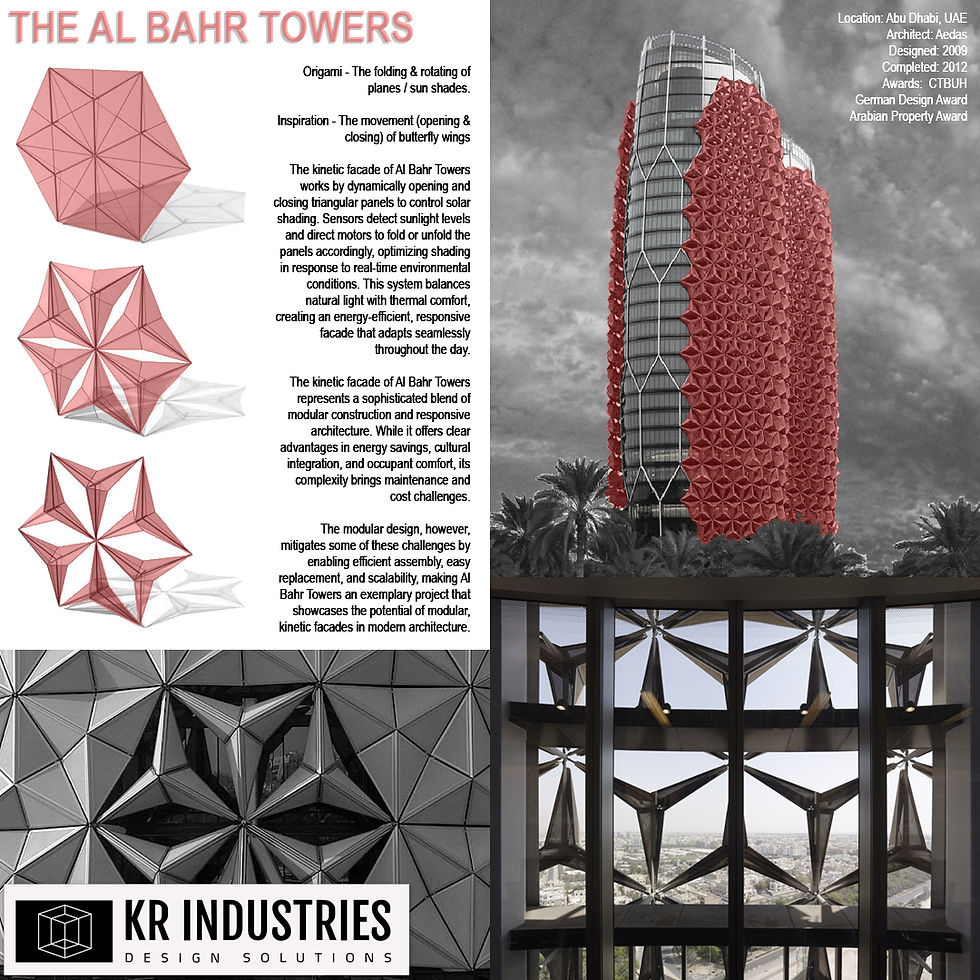
The Al Bahr Towers in Abu Dhabi, designed by Aedas, embody a harmonious blend of advanced modular construction and kinetic architectural prowess. This project showcases how responsive facades can elevate both environmental performance and cultural identity in urban architecture. Drawing from the traditional Islamic mashrabiya screen, the towers’ kinetic facade is more than a shield from the intense desert sun; it is a dynamic, adaptable structure that moves with the rhythm of the day, merging traditional values with forward-thinking technology.
Modular Innovation in a Kinetic Context
At the heart of Al Bahr Towers’ design is its pioneering kinetic facade, comprising over 1,000 triangular panels, each meticulously designed and prefabricated to align with a precise modular system. These triangular sun-shading units, constructed from glass-fiber reinforced PTFE (polytetrafluoroethylene), offer a lightweight yet durable solution that stands resilient against Abu Dhabi’s extreme weather conditions. The modularity here is twofold: each panel is a self-contained, individually operable unit, yet together they form a cohesive skin that enables the building to adapt fluidly to environmental changes.
By prefabricating each panel off-site, the design and engineering teams achieved a high degree of quality control and precision. These modular panels were manufactured to exacting specifications, reducing material waste and allowing rapid on-site assembly, a hallmark of efficient modular construction. Each panel’s modularity allows it to be removed, serviced, or upgraded independently without interrupting the performance or aesthetic continuity of the overall facade—an invaluable feature in the context of long-term sustainability.
Engineering Environmental Responsiveness
The kinetic facade’s adaptability is its defining attribute. Controlled by photocell sensors strategically placed across the building’s surface, the panels track sunlight in real time, responding dynamically to the sun’s intensity and position. At dawn, when the sunlight is soft, the panels open wide to welcome natural light into the interior, creating a warm, naturally lit environment. As the sun rises to its zenith, the panels gradually fold inward, creating a protective barrier against the harsh midday sun. By reducing solar gain by up to 50%, the facade mitigates the building’s cooling requirements, enabling a sustainable approach to energy consumption—a critical factor in the arid climate of Abu Dhabi.
The facade’s daily movement is akin to the aperture of a camera, adjusting to balance light and heat, allowing the building to breathe and adapt with remarkable efficiency. This intricate mechanism not only maintains a comfortable internal climate but also establishes a dynamic visual narrative on the building’s exterior. Observers see the facade as a living entity, continuously shifting and interacting with the surrounding environment.
Balancing Aesthetic Integrity with Practicality
The Al Bahr Towers project is an ode to thoughtful design where aesthetics and functionality exist in perfect harmony. The triangular panels, inspired by the mashrabiya screens that define much of traditional Middle Eastern architecture, establish a strong cultural connection. The facade, while futuristic in its kinetic capability, reflects a profound respect for regional heritage, transforming an ancient concept into a high-performance, sustainable solution.
The facade’s patterned shading creates an interplay of light and shadow, lending an iconic and instantly recognizable aesthetic to the towers. From afar, the movement of the panels appears choreographed, an architectural ballet reflecting both the art and engineering behind this adaptive system. This is not merely a facade but a cultural statement, blending the rich heritage of Islamic architecture with the demands of modern, sustainable design.
Precision in Modularity: The Key to Longevity
The modular design of each kinetic panel is essential not only for the facade’s adaptability but also for its resilience and longevity. Each module is a standalone unit, calibrated to function both independently and as part of a larger system. This modular approach has significant advantages in terms of maintenance and future-proofing. In an era where sustainability demands consideration beyond initial construction, the ability to replace, service, or upgrade individual panels ensures that Al Bahr Towers can adapt to technological advancements without disrupting the integrity of the design.
This design foresight is crucial for the future of kinetic architecture. Al Bahr Towers exemplify how modularity, when combined with cutting-edge engineering, can support a high-maintenance structure without compromising efficiency or functionality. This kind of modular kinetic facade sets a precedent for future projects, highlighting the potential of modular architecture to support not only adaptability but also sustainable, long-term operation.
The Value of Innovation in Maintenance and Performance
Al Bahr Towers’ kinetic facade requires specialized maintenance, a fact that speaks to the sophisticated nature of the system. With annual maintenance costs estimated between $160,000 and $290,000 USD, the upkeep involves routine cleaning, mechanical inspections, and calibration of the sensors and motors that drive the facade’s movements. This investment underscores the value placed on innovation in architectural performance, as well as the importance of maintaining the facade’s responsiveness in Abu Dhabi’s extreme climate.
Yet this maintenance is not a drawback; rather, it is a testament to the significance of the facade’s role in reducing energy consumption and enhancing the building’s environmental sustainability. The facade’s adaptability not only limits solar heat gain but also offers a balance of natural light, minimizing the need for artificial lighting and mechanical cooling. In essence, the maintenance cost is an investment in sustainable building practices, a necessary commitment to keep such a pioneering system performing at its peak.
Al Bahr Towers: A Blueprint for the Future
Al Bahr Towers stand as a transformative model for kinetic facades, combining modularity, environmental responsiveness, and cultural resonance in one cohesive structure. The project encapsulates a vision for the future where buildings interact with their environment, respond to natural conditions, and incorporate cultural context into their designs.
The kinetic facade, more than just a technological marvel, exemplifies how architecture can merge heritage with innovation. As architects, engineers, and designers, we look to Al Bahr Towers as a reminder of what’s possible when modular construction and adaptive facades converge. This project is not only a landmark on the Abu Dhabi skyline but also a symbol of the sustainable, culturally integrated architecture that the world’s best are continually striving to achieve.


Comments